 Sexual Health & NeuroendocrineIn Stock
Sexual Health & Neuroendocrine
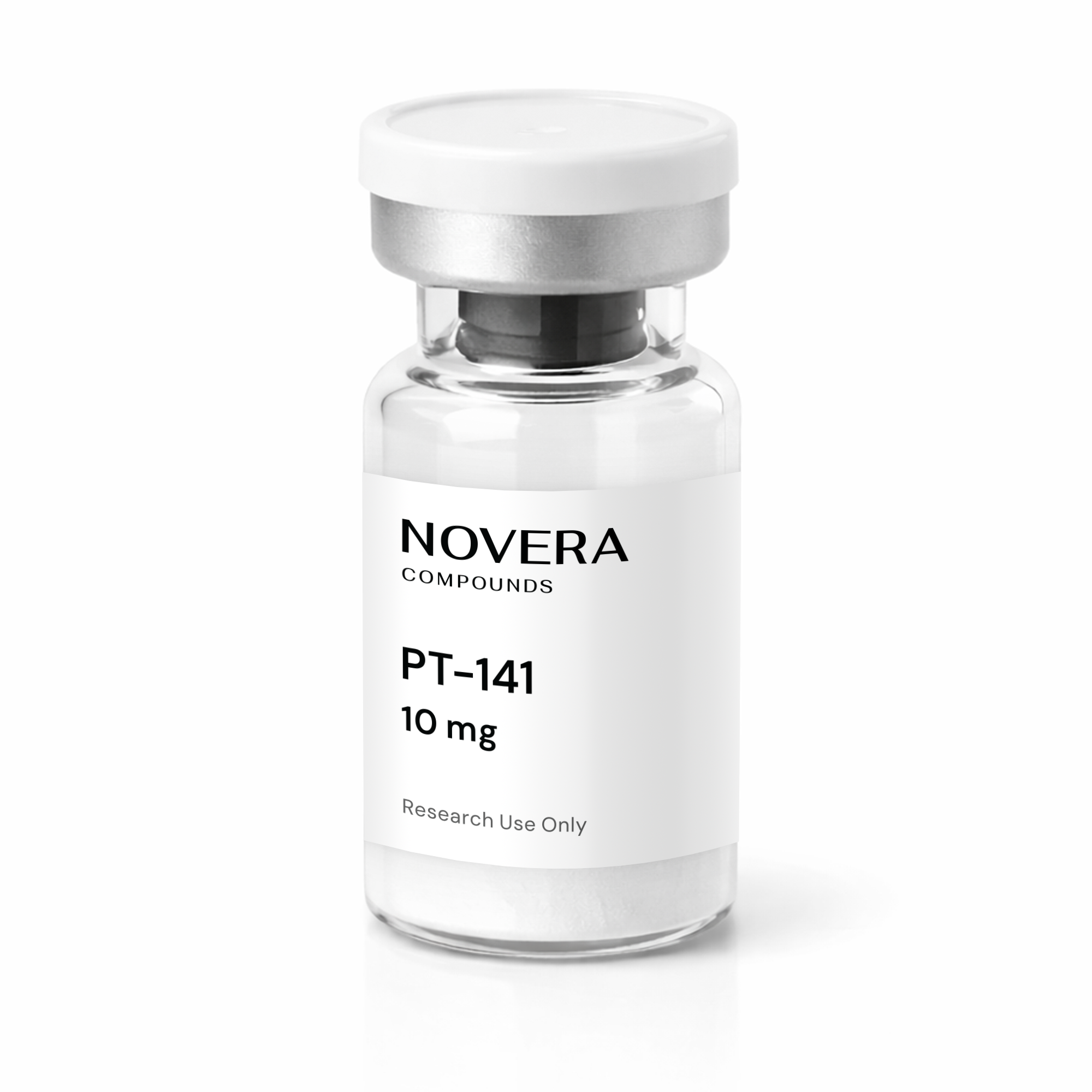
PT-141
Also known as: Bremelanotide; parent drug: Vyleesi
Synthetic cyclic heptapeptide melanocortin receptor agonist selective for MC3R and MC4R central-nervous-system pathways.
PT-141 (bremelanotide) is a synthetic cyclic heptapeptide derived from α-melanocyte-stimulating hormone (α-MSH).
It was developed from Melanotan II as a more selective melanocortin receptor agonist — removing MC1R-mediated effects (skin pigmentation) to focus on MC3R and MC4R central-nervous-system pathways.The parent pharmaceutical, marketed as Vyleesi (AMAG Pharmaceuticals/Palatin Technologies), is FDA-approved for a specific clinical indication in hypoactive sexual desire disorder (HSDD) in premenopausal women.
This catalog entry refers exclusively to research-grade material for in-vitro investigation of melanocortin-receptor pharmacology.In the research literature, PT-141 is studied for CNS-mediated effects on sexual function, melanocortin-pathway pharmacology, cyclic-peptide stability research, and comparative melanocortin-family receptor biology.
Research applications
- MC3R and MC4R selective agonist pharmacology
- Central-nervous-system melanocortin-pathway research
- Cyclic-peptide structure-activity research
- Comparative melanocortin agonist biology (vs. MT-II)
- Hypothalamic and limbic signaling studies
Technical profile
- Molecular formula
- C50H68N14O10
- Molecular weight
- 1025.18 g/mol
- CAS
- 189691-06-3
- Sequence
- Ac-Nle-Asp(1)-His-D-Phe-Arg-Trp-Lys(1)
For research use only. Not for human or veterinary consumption. Not intended to diagnose, treat, cure, or prevent any disease. Catalog availability restricted to verified licensed practitioners.
PT-141 (Bremelanotide) is a melanocortin receptor agonist derived from Melanotan II. Unlike PDE5 inhibitors, it acts centrally through the nervous system via MC4R activation and is studied for its role in sexual arousal and desire pathways.